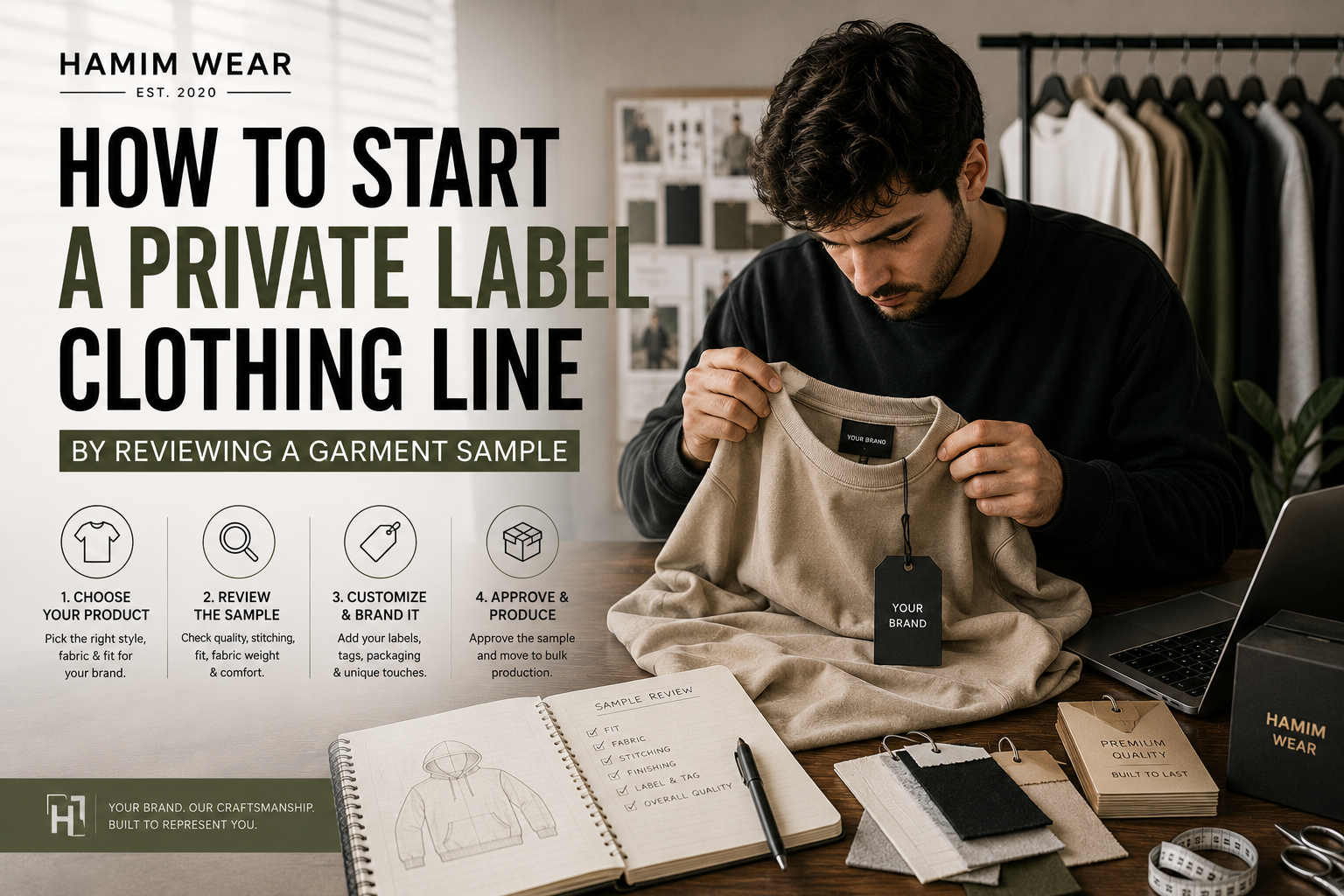
how to start a private label clothing line by reviewing a garment sample

How to Start a Private Label Clothing Line: 9 Proven Steps

How to Start a Private Label Clothing Line: 9 Proven Steps

If you’re wondering how to start a private label clothing line, the good news is you don’t need a factory, a warehouse, or six figures in savings. You need a clear niche, a manufacturing partner you trust, and a plan that starts small on purpose.

This guide walks through the process in order  from defining your niche to placing your first bulk order so you can move forward without guessing at what comes next.

What Does “Private Label Clothing Line” Actually Mean?

A private label clothing line means you sell garments under your own brand name, even though a manufacturer produces them. You control the design, fabric, fit, and branding; the manufacturer handles pattern work, cutting, sewing, and finishing.

Step 1: Define Your Niche Before Anything Else

The most common mistake in learning how to start a private label clothing line is skipping this step. “I want to sell clothes” isn’t a niche. “Heavyweight streetwear hoodies for men who want oversized fits and minimal branding” is.

Step 2: Research Your Market and Competitors

Look at who’s already selling to your audience. Note their price points, fabric quality, and what reviews complain about. Gaps in quality or service are usually easier entry points than gaps in style alone.

Step 3: Set a Realistic Budget

You can start a private label clothing line with a modest budget if you keep your first collection small three to five core pieces rather than a full range. Budget for photography, packaging, a basic website, and marketing too. Unsold stock from an overambitious first order is the most expensive mistake new brands make.

Step 4: Choose the Right Manufacturer

Look for low minimum order quantities, samples before bulk production, and clear communication on lead times and costs. Before committing, run through a proper checklist of questions to ask a clothing manufacturer this single conversation prevents most expensive surprises.

Step 5: Design and Sample Before You Commit

Develop your design into a physical sample before ordering in bulk. Review fit, fabric, and finish here  not after 200 units are already cut and sewn. For more control over fabric and construction, look into private label clothing manufacturing specifically.

Step 6: Confirm Customization and Branding Details

Labels, hang tags, and packaging are what make a private label clothing line feel like a real brand rather than a blank with a logo. Confirm your manufacturer handles embroidery, screen printing, and packaging in-house.

Step 7: Start Small With Your First Production Run

You don’t need thousands of units for a first order. A low MOQ clothing manufacturer lets you test a design before committing to a larger run.

Step 8: Choose Your Sales Channels

Decide where you’ll sell before your product arrives  Shopify, Etsy, or wholesale/B2B. Prepare product pages and marketing in advance; don’t wait until inventory lands.

Step 9: Handle the Legal Basics

Register your business appropriately, and consider trademarking your brand name early. The U.S. Small Business Administration’s step-by-step business guide is a solid reference, and the USPTO’s trademark basics page explains what’s actually required to protect a name.

How Long Does It Take to Start a Private Label Clothing Line?

Most brands take 6–10 weeks: 2–3 weeks for sample development, 3–4 weeks for bulk production, plus time for photography, packaging, and marketing prep.

FAQs: How to Start a Private Label Clothing Line

How much money do I need to start a private label clothing line?
A small first collection can start with a modest budget if limited to a few core styles and a low MOQ. Larger launches need significantly more capital.

What’s the difference between private label and white label clothing?
Private label allows close customization of fabric, fit, and branding; white label uses a generic product with only your logo applied.

Do I need a tech pack to start a private label clothing line?
Not necessarily — a clear sketch with measurements is often enough to start, though a full tech pack speeds up sampling accuracy.

What is a realistic MOQ for a first private label order?
Many manufacturers offer 50–100 pieces per style for new brands, depending on fabric and customization complexity.

How do I find a reliable manufacturer for my private label clothing line?
Ask for physical samples, confirm factory ownership and QC process, and review a full questions to ask a clothing manufacturer checklist first.

Where Hamim Wear Fits In

We work with startup brands through exactly this process  low MOQ production, private label customization, full in-house cut and sew out of Sialkot, Pakistan. Book a free consultation and we’ll walk through your design, budget, and timeline together.

6 Timeless Reasons Premium Apparel Clothing Still Wins Today

6 Timeless Reasons Premium Apparel Clothing Still Wins Today

Walk into any wardrobe that’s stood the test of time, and you’ll notice something: the pieces that survived years of wear aren’t always the flashiest ones. They’re the ones made from premium apparel clothing garments built with better fabric, tighter stitching, and a fit that doesn’t fall apart after a few washes.

This isn’t a pitch for any one brand. It’s a look at why “premium” became a word worth paying attention to in clothing, and how that idea eventually led to companies like Hamim Wear.

What Premium Apparel Clothing Actually Means

The word “premium” gets used loosely in fashion marketing, but the original meaning is simple: better raw materials, better construction, and better longevity than mass-market fast fashion.

That usually comes down to a few measurable things:

  • Fabric weight and composition heavier, breathable cotton or well-blended fibers instead of thin, scratchy synthetics.
  • Stitching density more stitches per inch means seams that don’t unravel after a year.
  • Cut and fit  patterns designed around how people actually move, not just cheap templates.
  • Finishing details reinforced collars, tagless prints, quality zippers and buttons.

None of this is complicated. It’s simply the difference between clothing made to be replaced and clothing made to be worn.

A Short History of “Better Made” Clothing

Before fast fashion existed, most clothing was premium by default tailors and small manufacturers built garments meant to last years, not weeks. Industrialization brought speed and lower prices, but it also introduced a tradeoff: cheaper materials and faster production cycles.

By the late 20th century, a counter-movement emerged. Brands began marketing “premium” and “heavyweight” lines specifically because customers wanted the durability that had quietly disappeared from everyday clothing. That shift is well documented in fashion industry retrospectives, including general overviews on sites like Wikipedia’s page on the history of fast fashion, which trace how manufacturing speed changed consumer expectations over decades.

Why People Are Willing to Pay More

Ask anyone who’s switched to buying fewer, better clothes why they made the change, and the reasoning tends to repeat itself.

  1. Cost per wear drops over time a shirt that lasts five years costs less per wear than five cheap shirts.
  2. Comfort compounds better fabric feels better against skin for years, not just on day one.
  3. Fewer replacements, less waste durability quietly reduces environmental impact.
  4. Consistent sizing and fit premium producers tend to standardize patterns more carefully.

None of these reasons require brand loyalty. They’re just math and comfort, which is exactly why the category keeps growing.

The Emotional Side of Quality Clothing

There’s a reason a well-made jacket or a heavyweight tee becomes a “favorite” the one you reach for without thinking. Fabric that holds its shape and color after dozens of washes builds trust in a way cheap clothing never can. Premium apparel clothing isn’t just about status; it’s about clothes you don’t have to think about replacing.

That trust is hard to manufacture through marketing alone. It has to be earned through the actual product.

Where Hamim Wear Fits Into This Story

This is where Hamim Wear enters the picture not as a shortcut, but as a continuation of the same idea. Hamim Wear focuses on the fundamentals described above: solid fabric weight, careful stitching, and fits that hold up beyond the first few wears.

Rather than chasing trends, the approach mirrors what “premium” always meant before it became a marketing buzzword clothing built to be worn, not just bought. Whether it’s everyday basics or custom pieces for a brand or event, the same standard applies: fabric and finish first, everything else second.

What to Check Before You Buy “Premium”

Not everything labeled premium actually earns the word. A few questions help separate real quality from marketing language:

  • What’s the fabric composition and weight (GSM for cotton items)?
  • Are seams double-stitched or reinforced at stress points?
  • Does the brand offer size consistency across different batches?
  • Can they show samples or close-up photos of construction, not just lifestyle shots?

A brand that can answer these clearly is usually one that actually invests in the product, not just the packaging.

Frequently Asked Questions

1. What makes clothing “premium apparel clothing” instead of regular clothing? It typically comes down to heavier, higher-quality fabric, stronger stitching, and better fit and finish details that hold up over repeated washing and wear.

2. Is premium clothing worth the extra cost? For most people, yes over time, cost per wear is often lower than repeatedly replacing cheaper garments, and comfort and fit improve noticeably.

3. How can I tell if a piece of clothing is genuinely premium? Check fabric weight (GSM), stitching density, and finishing details like collars and seams these are more reliable indicators than price alone.

4. Does premium clothing require special care? Most premium garments do best with cold washes and air drying, but many are designed to be low-maintenance despite the higher quality build.

5. Is premium apparel clothing more sustainable? Generally, yes because it lasts longer, it reduces the frequency of replacement purchases, which lowers overall textile waste per person.

Ready to Feel the Difference in Quality?

If this story sounds like the standard you want in your own wardrobe or brand merchandise, Hamim Wear is ready to help built on fabric and fit that hold up long after the trend fades.

📞 Contact Hamim Wear today to explore premium apparel clothing options, ask about fabric samples, and get a personalized quote.

👉 Get Your Free Quote Now reach out to Hamim Wear and upgrade your wardrobe or brand today.

custom tees screen printing ink being cured onto fabric

7 Reasons Custom Tees Screen Printing Never Goes Out of Style

Custom Tees Screen Printing: 5 Secrets Behind Shirts That Last

Custom tees screen printing has a story behind almost every shirt you’ve ever loved wearing. Not the marketing story the actual, physical one. Ink pressed into fiber, one color at a time, on a machine that hasn’t changed much in fifty years.

Here’s how that process really works, why it still beats flashier alternatives, and what separates a print that fades after three washes from one that outlives the shirt itself.

Where Custom Tees Screen Printing Actually Began

Picture a small event committee ordering shirts for a weekend fundraiser. Someone’s cousin knows “a guy with a machine in his garage.” The design is one color, the budget is tight, and the deadline is Friday.

That garage setup a wooden frame, a mesh screen, a squeegee, and a lot of patience is close to how custom tees screen printing has worked since the technique became commercial in the mid-20th century. A stencil blocks ink everywhere except where the design should sit, and the squeegee forces ink through the mesh onto the fabric below.

It sounds almost too simple. That simplicity is exactly why it’s lasted this long.

What Custom Tees Screen Printing Actually Involves

Every finished shirt goes through the same basic sequence, whether it’s made in a garage or a full production facility:

  1. Design separation the artwork is split into individual colors, since screen printing lays down one solid color per screen.
  2. Screen creation a mesh screen is coated and exposed so ink only passes through the design area.
  3. Press setup the garment is loaded and aligned under the screen, color by color.
  4. Printing ink is pulled across the screen with a squeegee, transferring the design onto the fabric.
  5. Curing the print is passed through a heat tunnel or press to bond the ink permanently into the fibers.

Skip or rush any one of these steps, and you get the classic problems: cracking ink, faded logos, or a print that peels after a handful of washes.

Why Custom Tees Screen Printing Still Beats Newer Methods

Digital and direct-to-garment (DTG) printing have gotten good genuinely good, for small runs and photo-realistic designs. But for solid colors, bold logos, and anything printed in bulk, screen printing usually still wins on two fronts: cost per unit drops sharply as quantity goes up, and the ink sits more solidly in the fabric than most digital methods, which shows up as better wash durability over time.

That trade-off is why screen printing remains the default for team merch, event shirts, and brand launches, even in a world full of print-on-demand options.

The 5 Secrets Behind Prints That Actually Last

1. Ink type matters more than most people realize. Plastisol ink sits on top of the fabric and holds color extremely well. Water-based ink soaks into the fibers for a softer feel but needs more careful curing. Neither is “better” they’re suited to different fabrics and finishes.

2. Fabric prep is half the job. Lint, moisture, or uneven fabric tension can ruin an otherwise perfect print before the ink even touches the shirt.

3. Mesh count changes the outcome. A finer mesh captures more detail; a coarser mesh lays down more ink for bold, solid colors. Using the wrong count for the design is a common rookie mistake.

4. Curing temperature is non-negotiable. Under-cured ink looks fine on day one and cracks within a month. Proper curing is what actually makes custom tees screen printing durable, not just good-looking in photos.

5. Registration accuracy separates amateurs from professionals. Multi-color designs need every screen aligned precisely. Even a millimeter of drift creates a blurry, unprofessional finish.

When Custom Tees Screen Printing Isn’t the Right Fit

It’s worth saying plainly: screen printing isn’t always the answer. Extremely small orders, gradient-heavy photos, or designs with dozens of colors are usually better suited to digital printing, where there’s no per-color screen cost to worry about. Choosing the right method for the design in front of you matters more than defaulting to whichever one sounds more “premium.”

From Story to Shirt: Where Hamim Wear Fits In

This is the process start to finish that sits behind every screen-printed order we run at Hamim Wear. We handle custom tees screen printing as part of our full production process in Sialkot, Pakistan: sourcing the right fabric weight, prepping it properly, and curing every print the way this guide describes, so the shirt your customer buys still looks right after the twentieth wash, not just the first.

If you’ve read this far because you’re actually planning a print run for a brand, a team, or an event we’re happy to talk through what your design needs. You can browse more on our blog, including our breakdown of t-shirt manufacturing FAQs, or head straight to our contact page to reach the team directly.

FAQs About Custom Tees Screen Printing

How long does custom tees screen printing last? A properly cured screen print on the right fabric can last 50+ washes without significant fading, whereas an under-cured print may start cracking within a few weeks.

Is screen printing cheaper than DTG for custom tees? For bulk orders with simple designs, yes — screen printing’s cost per unit drops significantly at scale. For small orders or highly detailed designs, DTG is often more cost-effective.

What’s the minimum order for custom tees screen printing? This varies by printer, but screen printing generally becomes cost-effective starting around 24–50 pieces per design, since each additional color requires its own screen setup.

Can screen printing be done on dark fabrics? Yes, using an underbase layer typically white ink printed first so the design colors show accurately on top of a dark garment.

Is screen printing eco-friendly? It can be, depending on the ink used. Water-based and eco-friendly inks reduce environmental impact compared to traditional plastisol, and some are certified under standards like OEKO-TEX, which tests for harmful substances in textiles.

Ready to Talk Through Your Print Run?

Whatever stage your idea is at, we’re happy to help you figure out the right approach for your custom tees screen printing project. Reach the Hamim Wear team through our contact page, or book a free consultation to walk through fabric, print method, and timeline together.

small batch cutting process used by a low MOQ clothing manufacturer for startups

Low MOQ clothing manufacturer for startups

Low MOQ Clothing Manufacturer for Startups: What You Need to Know Before You Order

If you’ve been quoted “MOQ 500” by every factory you’ve contacted, you already know the problem: most manufacturers aren’t built for small brands. A low MOQ clothing manufacturer for startups solves this by accepting small batch orders often as low as 20, 100 pieces per design so you can launch, test, and grow without burning your entire budget on unsold inventory.

This guide covers what MOQ actually means, why it varies so much between factories, what to prepare before you reach out, and how Hamim Wear works as a low MOQ clothing manufacturer for startups based in Sialkot, Pakistan.

What Does MOQ Mean in Clothing Manufacturing?

MOQ (Minimum Order Quantity) is the smallest number of units a factory will produce in a single run. It’s not an arbitrary number — it’s driven by fabric purchasing, cutting setup, machine calibration, and labor planning. A factory has to spread these fixed costs across enough units to stay profitable, which is exactly why a low MOQ clothing manufacturer for startups structures its process differently from a factory built for 5,000-unit retail orders.

Why Startups Specifically Need a Low MOQ Clothing Manufacturer

  • You’re testing, not scaling yet. You don’t know which colorway or size run will sell until real customers buy it.
  • Cash flow is tight. Every dollar sitting in unsold hoodies is a dollar you can’t spend on marketing or your next drop.
  • Trends move fast. A low MOQ clothing manufacturer for startups lets you launch a capsule collection without a six-month commitment.
  • Mistakes are cheaper. If a first sample needs adjustment, you’re not stuck reworking a warehouse full of stock.

Typical MOQ Benchmarks by Product

Product Typical MOQ Range Notes
T-shirts 30–200 pieces Simple fabric, lower setup cost
Hoodies 300–300 pieces Heavier fabric, more trims
Fleece / sweatshirts 100–250 pieces Depends on customization
Embroidered items 50–300+ pieces Setup cost per design increases MOQ

These numbers vary by manufacturer, so always confirm whether the MOQ applies per style, per color, or per size  these are three different numbers, and mixing them up is the most common mistake new brands make.

What Actually Drives MOQ Up or Down

  1. Fabric type stock fabrics (like standard cotton fleece) support lower MOQ than custom-dyed or specialty blends.
  2. Design complexity  a plain hoodie needs less setup than one with embroidery, contrast panels, or custom hardware.
  3. Customization method  screen printing generally allows smaller runs than techniques requiring dedicated tooling.
  4. Color and size spread  fewer colorways and a tighter size range keep your total order smaller and easier to approve.

How to Prepare Before Contacting a Low MOQ Clothing Manufacturer

Factories respond faster  and quote more accurately  when you show up with:

  • A tech pack or a clear sketch with measurements
  • Your target unit quantity per style
  • Fabric weight and blend preference (or ask for recommendations)
  • Customization details: printing, embroidery, labels, packaging
  • Your target ship date

A rough sketch with notes is enough to start. You don’t need a professionally drafted tech pack for your first conversation.

How Hamim Wear Works as a Low MOQ Clothing Manufacturer for Startups

  1. Free consultation  book a call and share your design, quantity, and timeline.
  2. Design & mockups we turn your concept into a visual mockup before any fabric is cut.
  3. Fabric sourcing we recommend fabric weights that keep your MOQ realistic without cutting quality.
  4. Sample approval you review fit, fabric, and finish before bulk production starts.
  5. Small-batch production cut and sew begins once your sample is approved.
  6. Customization embroidery, chenille, screen printing, labels, and packaging are added in-house.
  7. Quality inspection & shipping every order is checked before it ships worldwide, typically within 21, 28 days.

If you later want more control over branding and fabric selection, read our guide on private label clothing manufacturing  the natural next step once your low-MOQ test run proves demand.

Common Mistakes When Working With a Low MOQ Clothing Manufacturer

  • Assuming “MOQ 100” means 100 total, when it may mean 100 per color.
  • Skipping the sample stage to “save time” this is where most quality issues get caught early.
  • Choosing complex customization (multiple colorways, specialty trims) on a first order, which pushes MOQ higher than necessary.
  • Not confirming sampling and production lead times separately  they’re rarely the same number.
  • Paying 100% upfront. A standard structure is a deposit to start, with the balance due before shipment.

FAQs About Low MOQ Clothing Manufacturers

What is a good MOQ for a startup clothing brand? Many low MOQ clothing manufacturers for startups accept 20–100 pieces per design, though this depends on the product and customization involved. Simpler designs with stock fabric generally support the lowest minimums.

Is MOQ the same for every color and size? Not always. Some manufacturers set MOQ per style, others per color or per size run. Always confirm this before quoting your budget, since it can significantly change your total order size.

Can I negotiate MOQ with a clothing manufacturer? Yes, in many cases. Simplifying your design  one fabric, one print method, fewer colorways  is usually more effective than negotiating on price alone.

What should I prepare before contacting a low MOQ clothing manufacturer? A tech pack or detailed sketch, your target quantity, fabric preference, customization details, and your ship date. This lets the manufacturer quote accurately on the first conversation.

Do low MOQ manufacturers still offer private labeling? Yes. A full-service low MOQ clothing manufacturer for startups can include custom labels, tags, and packaging even on small runs, so your first batch still looks fully branded.

How long does a small batch order take to produce? Sample development typically takes about two weeks, with bulk production following in roughly 21, 28 days depending on order size and customization.

Ready to Launch Your First Small Batch?

You don’t need a 500-unit order to start a real clothing brand. Book a free consultation with Hamim Wear and let’s scope a low-MOQ first run that fits your budget and timeline.

T-Shirt Manufacturing FAQs | Hamim Wear

T-Shirt Manufacturing FAQs

T-Shirt Manufacturing FAQs answer the most common questions about custom T-shirt production, fabric selection, printing methods, private label manufacturing, minimum order quantities, and shipping. Whether you’re launching a new clothing brand or expanding an existing collection, Hamim Wear is here to guide you through every step of the manufacturing process.

Frequently Asked Questions

1. What types of T-shirts Manufacturing ?

We manufacture oversized, regular fit, relaxed fit, athletic, heavyweight, vintage wash, acid wash, and custom cut-and-sew T-shirts.

2. What fabrics used for T-Shirt Manufacturing?

We offer 100% cotton, cotton blends, organic cotton, French Terry, jersey knit, polyester, and performance fabrics.

3. What GSM is best for T-shirts?

Popular GSM options include:

  • 180 GSM
  • 200 GSM
  • 220 GSM
  • 240 GSM
  • 260 GSM
  • 280 GSM

The ideal GSM depends on your brand and intended use.

4. Can I create my own T-shirt design?

Yes. We manufacture custom T-shirts based on your artwork, tech pack, sketches, or sample garments.

5. Do you offer private label manufacturing?

Yes. We provide complete private label services including custom neck labels, woven labels, wash labels, hang tags, packaging, and branding.

6. What printing methods do you offer?

We provide:

  • Screen Printing
  • Puff Printing
  • DTF Printing
  • DTG Printing
  • Plastisol Printing
  • High Density Printing
  • Silicone Printing
  • Embroidery

7. What is your minimum order quantity?

Our MOQ depends on the product, fabric, and customisation requirements. Contact us for a quotation based on your project.

8. Can I order a sample first?

Yes. Sample development is recommended before bulk production to ensure the final product meets your expectations.

9. How long does production take?

Production timelines depend on the order size and level of customisation. We’ll provide an estimated lead time once your order details are confirmed.

10. Do you manufacture oversized T-shirts?

Yes. Oversized T-shirts are one of our most popular products for streetwear and fashion brands.

11. Can you match Pantone colours?

Yes. We offer Pantone colour matching for fabrics and prints to ensure consistency with your brand identity.

12. Do you ship internationally?

Yes. Hamim Wear ships custom T-shirts worldwide, including the UK, USA, Europe, Australia, and many other countries.

13. How much does custom T-shirt manufacturing cost?

Pricing depends on factors such as fabric, GSM, quantity, printing, embroidery, trims, and packaging. Contact us for a personalised quotation.

14. Do you help clothing startups?

Absolutely. We work with startups, independent brands, influencers, and established fashion companies.

15. How do you ensure quality?

Every T-shirt is inspected during production and before shipment to maintain consistent quality standards.

Contact Hamim Wear

Looking for a reliable T-shirt manufacturer?

Whether you need premium blanks, private label production, or fully customised T-shirts, Hamim Wear is ready to help.

📧 Email: info@hamimwear.com

🌐 Website: www.hamimwear.com

📍 Location: Sialkot, Pakistan

🚚 Worldwide Shipping Available

Request a free quotation or book a meeting with Abdullah to discuss your next T-shirt manufacturing project.

Heavyweight Hoodie Manufacturer

Luxury Hoodie Manufacturer

Luxury Hoodie Manufacturer

If you’re looking for a trusted Luxury Hoodie Manufacturer, Ha-mim Wear produces premium-quality hoodies for fashion brands, streetwear labels and retailers worldwide. We combine high-quality fabrics, expert craftsmanship and custom manufacturing to help brands create luxury garments that stand out.

Our luxury hoodies are manufactured using premium cotton, cotton fleece and French Terry fabrics ranging from 320 GSM to 600 GSM, delivering exceptional comfort, durability and a premium finish.

Why Choose Ha-mim Wear for Luxury Hoodie Manufacturer ?

Luxury clothing requires attention to every detail. At Ha-mim Wear, we work closely with brands to manufacture hoodies that reflect premium quality from fabric selection to final packaging.

Our Services

  • Private Label Manufacturing
  • Custom Hoodie Production
  • Heavyweight Hoodies
  • Oversized Hoodies
  • Luxury Streetwear Manufacturing
  • Low Minimum Order Quantities
  • Worldwide Shipping

Premium Fabric Options for Luxury Hoodie Manufacturer ?

Selecting the right fabric is one of the most important steps when creating a luxury hoodie.

Cotton Fleece

Perfect for soft, warm and premium hoodies with an excellent structure.

French Terry

Ideal for luxury streetwear with a smooth exterior and breathable interior.

Heavyweight Cotton

Available from 320 GSM to 600 GSM, providing durability and a premium feel suitable for modern fashion brands.

Customization Options

Every brand has its own identity. We offer complete custom manufacturing, including:

  • Custom Patterns
  • Pantone Colour Matching
  • Screen Printing
  • Puff Printing
  • High-Density Printing
  • Embroidery
  • Woven Labels
  • Neck Labels
  • Hang Tags
  • Silicone Logos
  • Custom Packaging

Industries We Serve

Our luxury hoodies are manufactured for:

  • Streetwear Brands
  • Fashion Labels
  • Designer Clothing Brands
  • Premium Retailers
  • Influencer Brands
  • Clothing Startups
  • Corporate Merchandise

Our Manufacturing Process

Consultation

Share your design, fabric requirements and branding ideas.

Sampling

We produce samples for approval before bulk production.

Production

Our experienced team manufactures every hoodie with strict quality control.

Quality Inspection

Every garment is carefully inspected before packaging.

Worldwide Delivery

We ship luxury hoodies globally with reliable logistics partners.

Why Luxury Hoodies Are in Demand

Luxury hoodies have become a staple in modern fashion because customers expect premium fabrics, superior construction and timeless designs. High-quality hoodies also improve customer satisfaction, increase brand value and encourage repeat purchases.

Whether you’re launching a luxury streetwear label or expanding your premium apparel collection, investing in quality manufacturing makes a lasting impression.

Frequently Asked Questions

What makes a hoodie luxurious?

Luxury hoodies are made from premium fabrics, feature superior stitching, high-quality trims and professional finishing with custom branding.

What fabrics do you recommend for luxury hoodies?

Cotton fleece, French Terry and heavyweight cotton fabrics are the most popular choices for premium hoodies.

Can you manufacture private label luxury hoodies?

Yes. We provide complete private label manufacturing, including labels, embroidery, printing and custom packaging.

What is your minimum order quantity?

We offer flexible MOQs suitable for both startups and established clothing brands.

Can I customise every part of my hoodie?

Absolutely. We can customise the fit, fabric, colours, labels, packaging, embroidery, prints and accessories.

Do you ship internationally?

Yes. Hamim Wear supplies luxury hoodies to customers in the UK, USA, Europe, Australia and many other countries.

Contact Hamim Wear

Looking for a reliable Luxury Hoodie Manufacturer?

Our team is ready to help you develop premium hoodies that represent your brand.

Email: info@hamimwear.com

Website: https://hamimwear.com

Location: Sialkot, Pakistan

Worldwide Shipping Available

Request a quotation today and let Ha-mim Wear help bring your luxury hoodie collection to life.

Back to Top
Product has been added to your cart
Compare (0)